Share on LinkedIn
Seven warnings. On April 14, 1912, the RMS Titanic received at least seven ice warnings transmitted by other vessels while crossing the North Atlantic at 22.5 knots, nearly its top speed [1]. The night was clear, the sea was calm, and on board there was an unshakable confidence in the ship’s engineering. The official report of the United States Senate, published on May 28 of that year, was direct in describing what happened next: “the speed was not reduced,” “the lookout was not increased,” and “there was no general discussion among the officers to consider the ice warnings” [2]. Of the 2,223 people on board, about 1,500 died that night, the equivalent of a 68% mortality rate [3].
This is not just a story about a ship. It is a story about the way the human mind deals with risk and about what happens when perception drifts away from reality. The Titanic’s crew was not incompetent. The officers were experienced, procedures existed, and the technology was advanced for its time. What failed was something more subtle and perhaps more dangerous: the ability to recognize, in the present moment, that the signals around them required a change in behavior.
This phenomenon did not remain in 1912. It is present in projects approaching completion that begin to breathe a kind of quiet relief. It is present in industrial plants where a routine without incidents creates an illusory sense of control. It is present in every operation where someone thinks, “the worst is already behind us” or “the real risk comes later.” This article is about that mindset and about risk perception as a management tool in the past, the present, and the future.
1. Risk perception is not intuition. It is a management mindset
Before moving forward, it is important to distinguish between two concepts that are often confused. Risk is the combination of the probability of an undesired event and the severity of its consequences. Risk perception is the subjective judgment a person makes about the nature and magnitude of that risk [4]. The problem is that, in practice, these two elements rarely move together.
Cognitive psychology shows that human beings are notoriously flawed when it comes to evaluating risks objectively. Paul Slovic, one of the leading researchers in this field, showed that risk perception is influenced by factors such as familiarity, perceived control, fear, and voluntariness of exposure, and not only by the statistical probability of an event [4]. In other words, we tend to underestimate risks that feel familiar and overestimate those that feel new, unknown, or frightening.
For that reason, risk perception cannot be treated as a natural talent, nor as something that simply “comes with experience.” It must be developed as a management mindset: an active discipline that requires looking back to learn from past events, looking ahead to anticipate changes in the scenario, and, above all, looking at the now, where visible precursors can trigger an undesired event.
2. The past as a teacher, not as a shield
2.1 The trap of “the worst is already behind us”
In my most recent field visits, something has been repeating itself with unsettling frequency. Projects nearing completion begin to exhale a certain quiet relief. The team looks back and thinks, “we’ve already made it through the heaviest phases,” “no incidents happened, so we’re fine,” “now we just need to keep the pace and deliver.” In day-to-day project life, this phenomenon could be called the “almost done” effect.
This effect does not necessarily come from negligence. It is a documented cognitive trap. A study published in Safety Science on risk perception in construction projects showed that risks begin to be perceived as lower as the project advances, even when this reduction in perception does not correspond to a real reduction in risk [5]. By the end of a project, many things do in fact improve: cleaner areas, fewer interferences, more mature processes. But that visible improvement can create the illusion that the risk has already been overcome.
The final stretch, however, is not neutral. It brings its own risks and often more serious ones: rush to meet deadlines, last-minute scope changes, energization, commissioning, testing with live systems, reduced crews, and, not rarely, less supervision. An article on the commissioning phase describes exactly this blind spot: the final stage is often seen as the “last lap,” when in reality it is a transition period in which systems begin to be energized and tested; the tools may become quieter, but the risks do not [6].
2.2 The normalization of deviance: when the past misleads us
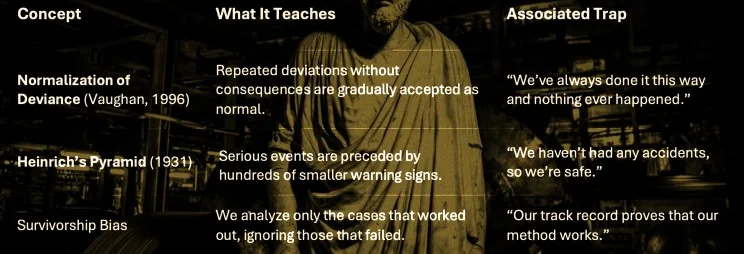
When investigating the Challenger space shuttle disaster in 1986, sociologist Diane Vaughan identified a pattern she called the “normalization of deviance” [7]. Before the explosion that killed seven astronauts, NASA engineers had already observed erosion in the booster rocket O-rings on previous flights. With each mission completed without disaster, the belief was reinforced that the deviation was acceptable. A past without incidents began to justify continuing an operation outside its design parameters.
As Vaughan describes it: “The normalization of deviance is the process by which a departure from a correct rule or behavior becomes so commonplace within an organization that it is no longer perceived as a deviation” [7].
This concept is deeply relevant to operational life. How many times does a team adapt a procedure and, because nothing happens, that adaptation becomes routine? How many times is a shortcut adopted under schedule pressure and, because the immediate result is positive, that shortcut becomes the new standard? The absence of an accident is not proof of safety. Many times, it is only proof of luck, or proof that the safety margins have not yet been fully consumed.
Heinrich’s Pyramid, proposed in 1931, offers a complementary perspective. Heinrich observed that for every serious accident there were approximately 29 minor accidents and 300 incidents without injury [8]. Later studies, such as analyses by the UK Health and Safety Executive, found even broader ratios: 1 fatality for every 207 serious injuries and 1,402 lost-time injuries [9]. The central message remains: before a serious event, the signs are usually there. The difference lies in whether we know how to see them or whether we have been convinced, by a past without tragedies, that they do not matter.
3. The future as a compass, not as an excuse
3.1 The trap of “the risk is up ahead”
The other temporal trap is to project risk entirely into the future. It is when someone says, “things are still calm here; the critical part is when more people come in,” or “the real risk is when commissioning starts,” or even “the heavier activity comes later.” By doing this, the team gives itself permission to operate on autopilot, as if the present were merely a waiting room for a danger that has not yet arrived.
This mindset ignores an essential fact: accidents do not keep appointments. They result from the convergence of conditions, decisions, and variability that happens, invariably, in the now. James Reason’s organizational accident model, known as the Swiss Cheese Model, helps illustrate this [10]. An organization’s defenses procedures, physical barriers, training, supervision work like stacked slices of cheese. Each slice has holes, but under normal conditions those holes do not align. The accident occurs when, at a specific moment, the holes in multiple layers align simultaneously and allow the hazard to pass through every barrier.
The key point is that these holes are not fixed. They open and close dynamically, influenced by decisions and by present conditions. When a team decides to relax now because it imagines the real risk will come later, it is, in practice, opening weaknesses in its own layers of defense. By projecting risk into the future, it may be creating the conditions for it to materialize in the present.
3.2 Revisiting the Titanic: when “getting through faster” becomes a strategy
Let us return to the Titanic, not to the myth, but to what was recorded in the investigations. Behind the decision to maintain speed despite the ice warnings was a logic that appears in many operational environments: the idea that speeding up helps leave the risk behind. If we cross the ice zone more quickly, we will be exposed for less time. It sounds intuitive. But it is a deeply flawed logic.
The U.S. Senate report records that the ice positions had been reported and that there is evidence the warnings reached the ship’s command, but there was no structured discussion among the officers to evaluate them [2]. The decision to maintain speed was not made by a villain. It was made by professionals embedded in a culture in which crossing the Atlantic in the shortest possible time carried enormous symbolic and operational value, and in which confidence in the ship’s technology outweighed careful reading of the environment.
Speeding up does not eliminate risk. Speeding up transforms risk and, in general, aggravates it because it reduces room for maneuver, response time, and decision quality. When delivery becomes the absolute priority, the present gets compressed. And a compressed present is a dangerous present: it is where decisions begin to be made with less information, less reflection, and less margin for error.
This pattern repeats itself in current contexts. The U.S. Bureau of Labor Statistics recorded 5,070 occupational fatalities in 2024 [11]. The National Safety Council estimates that complacency contributes to an average of 552 preventable deaths per day in the United States, considering different types of accidents [12]. Meanwhile, the U.S. Air Force, in a five-year analysis of safety data, identified complacency as a causal or contributing factor in 756 injury incidents [13]. The numbers converge on the same conclusion: when risk perception drops, exposure increases.
4. The present: where risk is born and where it can die
4.1 Risk is a verb
Risk is not a fixed point on the schedule. It is not “in phase 1” or “in phase 9.” Risk is dynamic. It happens now. It is in the change that occurred today, in the pressure to finish, in the team member who came in without knowing the environment, in the unexpected interference, in the energy that was released, in the small deviation that became routine, in the decision that almost no one realized they were making.
Situational awareness, a concept developed by Mica Endsley, is the ability to operate effectively in this dynamic present [14]. Endsley describes three levels of situational awareness that are essential to real-time risk management.
The first level is perception: identifying the relevant elements in the environment. It is seeing the ice warning, noticing that the team has changed, realizing that the tool is not the specified one. The second level is comprehension: understanding what those elements mean within the current context. It is not enough to see the ice warning; it is necessary to understand that, at the current speed and under the existing conditions, it represents a real threat. The third level is projection: anticipating what may happen next if nothing changes. If we maintain speed, if we do not reinforce the lookout, what is the likely scenario over the next few minutes?
A large part of risk perception failure occurs between the first and second levels. The signals are visible, but they are not interpreted as relevant. The seven ice warnings reached the Titanic. NASA engineers saw the erosion in the O-rings. Field teams live daily with small deviations. The problem is rarely a lack of information. The problem is the absence of discipline to process that information in the present and act on it.
4.2 Precursors: the risk before the risk
The U.S. National Academies of Sciences defined accident precursors as events that function, at the same time, as a test of the adequacy of the system’s defenses and as an opportunity to generate knowledge capable of preventing accidents [15]. Every near miss, every procedural deviation, every “close call” is a precursor a sign that the defenses are being put to the test.
The challenge is that precursors, by definition, do not produce immediate serious consequences. For that reason, they are easily dismissed, rationalized, or not even reported. A culture that treats precursors as “things that happen” wastes its best opportunities for prevention. By contrast, a culture that treats each precursor as a window into the future and as a sign that something in the system demands attention has its risk perception anchored in the present.
5. Tools for the present: what to bring to the field tomorrow
Theory without practice does not sustain change. The following tools are simple, immediately applicable, and act precisely at the moment when risk is born that is, before the event. They can be used both on a construction site and in a control room, both by a senior engineer and by an operator on their first day.
5.1 The intentional pause: the cognitive reset
Two minutes. Literally. Before starting any task, and especially whenever something changes, the team should stop and answer three objective questions:
What has changed since the last time we did this? This question forces the brain out of autopilot and helps it recognize that the present is not a repetition of the past.
Where might our experience mislead us today? This question directly fights overconfidence and the normalization of deviance.
What is our clear, agreed trigger for stopping everything? This question establishes, before the pressure appears, the limit that will not be crossed.
5.2 Dynamic reassessment triggers: if it changed, it changed
The team should agree in advance on a list of changes that function like an automatic breaker, requiring a new risk assessment during execution, not only during initial planning.
If the team changed or a contractor joined, the activity must be reassessed. If the tool or equipment changed, the activity must be reassessed. If the sequence or scope changed, the activity must be reassessed. If weather, visibility, or lighting changed, the activity must be reassessed. If urgency increased or the execution window was shortened, the activity must be reassessed. If an unplanned interference appeared, the activity must be reassessed.
The rule is simple: replanning is not wasting time. It is working responsibly.
5.3 The explicit stop-work agreement: permission to think
Before starting the work, three points need to be clear for the whole team. First: who can stop the activity? The answer must be unequivocal anyone who identifies an unmanaged risk, regardless of rank or role. Second: under what conditions is the stop automatic and non-negotiable? These conditions need to be defined concretely, such as communication failure, an unexpected change in the environment, or abnormal equipment behavior. Third: how will the work be safely resumed after a stop? This is not bureaucracy. It is a way of authorizing critical thinking in real time, without fear of retaliation.
5.4 Minimal, consistent, and verifiable communication
In the field, risk feeds on noise and ambiguity. A short, repeatable pattern helps reduce that:
I am going to do ___ The critical risk here is ___ My barrier is ___ If it fails, I will ___ or I will stop ___
This format forces the risk to be verbalized, activates situational awareness, and creates space for others to validate or question the analysis in real time.
5.5 Checking the obvious: why the obvious disappears in the final stretch
In the final stretch of any operation, it is common to relax what seems basic: isolation, signage, area organization, escape routes, work permits, energy control. The obvious is not small; it simply becomes invisible through repetition. That is why a deliberate check of the fundamentals especially when the team feels that “we’re almost done” is one of the most powerful tools against the “almost done” effect.
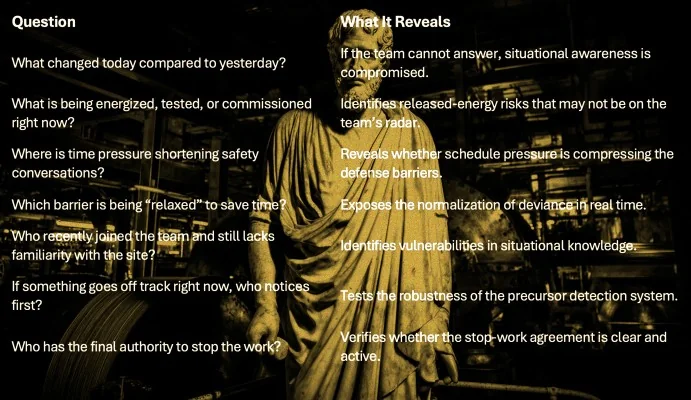
6. A mini-checklist for the next field visit
Before saying, “we’re almost there,” it is worth stopping and asking:
Closing: risk is in the present, and the present is where we need to be
Safety culture is not the memory of what has already gone right, nor the promise that when the critical phase arrives the team will do better. Safety culture is the discipline of honoring the present.
The past teaches. Through the normalization of deviance, Heinrich’s Pyramid, and tragedies like the Titanic and Challenger, it shows that the signals are usually there long before the serious event. The future guides. Through the Swiss Cheese Model and precursor analysis, it reminds us that the conditions for the accident are being built now, in the decisions we make or fail to make.
But everything is decided in the present. It is in the present that precursors can be noticed. It is in the present that the intentional pause can happen. It is in the present that the stop-work agreement can be activated. It is in the present that clear communication can prevent an irreversible loss. The accident is also built in the present, through small accumulated decisions, often silent ones.
That is why the central message of this article remains:
Risk is not in the past, nor in the future. Risk is in the present. And the present is where our tools, our attention, and our capacity to act need to be.
See you next time,
Andreza Araújo
References:
[1] Congress Investigates the Titanic Disaster. Levin Center at Wayne Law. Disponível em: https://levin-center.org/what-is-oversight/portraits/congress-investigates-the-titanic-disaster
[2] U.S. Senate. Report of the Senate Committee on Commerce: "Titanic" Disaster (Relatório 62-806, 28 de maio de 1912). Disponível em: http://www.senate.gov/artandhistory/history/resources/pdf/TitanicReport.pdf
[3] Royal Museums Greenwich. RMS Titanic Facts. Disponível em: https://www.rmg.co.uk/stories/maritime-history/rms-titanic-facts
[4] Slovic, P. (1987). Perception of Risk. Science, 236(4799), 280-285.
[5] Perception of risk in construction: Exploring the factors that influence experts. Safety Science, 2021. Disponível em: https://www.sciencedirect.com/science/article/abs/pii/S0925753520303878
[6] AXA XL. The Hidden Danger of Complacency on the Construction Site. Disponível em: https://axaxl.com/fast-fast-forward/articles/the-hidden-danger-of-complacency-on-the-construction-site
[7] Vaughan, D. (1996). The Challenger Launch Decision: Risky Technology, Culture, and Deviance at NASA. University of Chicago Press.
[8] Heinrich, H. W. (1931). Industrial Accident Prevention: A Scientific Approach. McGraw-Hill.
[9] Health and Safety Executive (HSE), UK. Accident triangle data, mid-1990s. Referência em: https://en.wikipedia.org/wiki/Accident_triangle
[10] Reason, J. (1990). Human Error. Cambridge University Press.
[11] U.S. Bureau of Labor Statistics. Census of Fatal Occupational Injuries, 2024. Disponível em: https://www.bls.gov/news.release/pdf/cfoi.pdf
[12] National Safety Council. Injury Facts. Disponível em: https://www.nsc.org/community-safety/resources/injury-facts
[13] U.S. Air Force Safety Center. Talking Paper on Complacency (FY11-FY15). Disponível em: https://www.safety.af.mil/Portals/71/documents/Occupational/Q4Z/Talking%20Paper%20on%20Complacency_final.pdf
[14] Endsley, M. R. (1995). Toward a Theory of Situation Awareness in Dynamic Systems. Human Factors, 37(1), 32-64.
[15] National Academies of Sciences. Accident Precursor Analysis and Management. Disponível em: https://www.nationalacademies.org/read/11061/chapter/10