Share on LinkedIn
Leadership communication is often full of subtle traps. Among the most dangerous is the paradoxical message, the kind that conveys two conflicting instructions at the same time. In Brazil, we have a perfect colloquial expression to illustrate this phenomenon, "Run Slowly", which means "run slowly". This popular oxymoron, which combines the urgency of running with the prudence of slowing down, reflects a common reality in the corporate environment, where managers demand immediate results while also requiring strict compliance with safety and quality procedures.
When a leader says "run slowly", they are, in practice, transferring to the team the burden of balancing incompatible pressures. The team understands the urgency of "run", but also realizes that, if something goes wrong, they will be held accountable for the "slowly" that was not respected. To understand the seriousness of this ambiguity and the impact that a poorly calibrated leadership message can have, we need to look at one of the greatest disasters in maritime history and analyze the behavior of one of the most powerful men of that era.
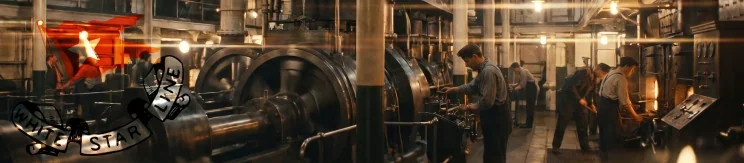
The tragedy of the RMS Titanic, which took place on the night of April 14, 1912, is often remembered for its collision with the iceberg and the tragic loss of more than 1,500 lives [1]. However, behind the technical and operational failures, there is a profound lesson about leadership and the invisible influence that an executive's words can have on their subordinates. At the center of this reflection is Joseph Bruce Ismay, chairman and managing director of the White Star Line, the company that owned the ship.
Bruce Ismay was aboard the Titanic during its maiden voyage as a voluntary passenger [2]. His presence there was not that of a technician, but of the business leader, the man who had commissioned the ship's construction and held ultimate power over the crew. During the voyage, survivor accounts indicate that Ismay had informal conversations with Captain Edward J. Smith and the chief engineer about the possibility of testing the ship's speed [3]. The idea implied between the lines was that arriving in New York on Tuesday evening, ahead of the expected Wednesday morning arrival, would be a remarkable surprise and would secure spectacular newspaper headlines [4].
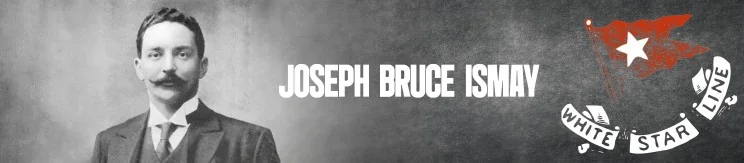
After the disaster, during the investigation conducted by the United States Senate, Ismay was harshly questioned about his influence on the ship's speed. In his sworn testimony, he categorically denied having exerted any pressure on Captain Smith. He stated that the ship had never reached its maximum speed and that there was no intention of breaking records, emphasizing that, as a passenger, he did not interfere with navigation [2]. Ismay's technical defense was solid. He did not issue an official order to increase speed.
However, the reflection that matters for modern leadership is not about the issuance of a formal order, but about the weight of an informal message. When the company's chairman suggests that "it would be very good if we arrived ahead of schedule", that phrase is not received by the team as a mere comment from an ordinary passenger. For Captain Smith, a loyal employee of the White Star Line, a suggestion from his boss carried the force of a directive. This is the classic corporate version of "run slowly". Ismay wanted the benefit of an early arrival, but without assuming direct responsibility for the risk of navigating at high speed in an area known for the presence of ice.
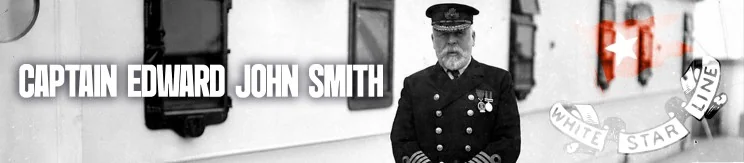
This dynamic illustrates the danger of inconsistency in leadership. When the tragedy occurred, Ismay was able to take refuge in the justification that "that was not what I meant" or "I did not give the order". However, the pressure for extraordinary results, communicated in a subtle and ambiguous way, shapes team behavior. Subordinates, eager to please leadership and demonstrate efficiency, end up taking risks they would not take under normal conditions. Captain Smith maintained the Titanic's speed at around 22 knots, even after receiving multiple ice warnings along the route, a decision that proved fatal [1].
What does your message mean to your team? As a leader, you may be delivering your own version of "run slowly" without realizing it. When you demand that a project be delivered in half the time, but end the meeting by saying "but do not compromise safety", which of the two messages will the team prioritize? Usually, the urgency imposed by tone of voice and business targets overrides the formal recommendation for caution. The result is a team operating at the limit, taking silent risks, while leadership preserves the alibi that it instructed everyone to do everything safely.
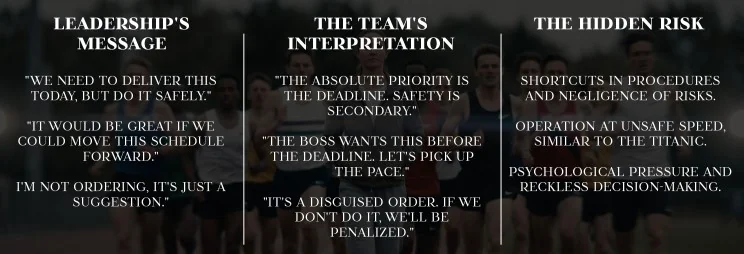
Bruce Ismay's story teaches us that a leader does not need to give a direct order to cause a disaster. An organization's culture is shaped by implicit expectations, unspoken incentives, and contradictory messages that come from the top. Extraordinary leadership requires absolute clarity. If safety is the priority, the message cannot contain caveats that encourage haste. If the deadline is nonnegotiable, the leader must provide the necessary resources so the team does not have to choose between quality and speed.
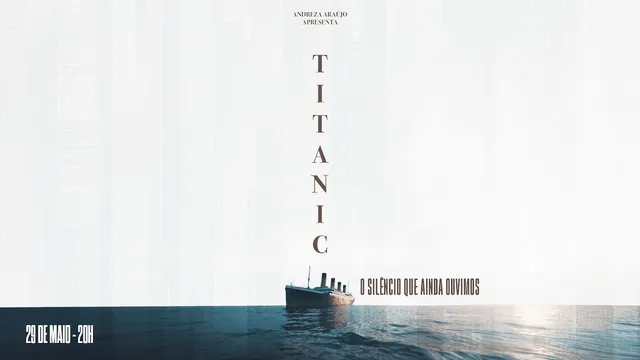
I invite you to reflect deeply on the clarity of your messages and their impact on your company's culture. To explore this discussion further and understand how failures in leadership and communication culminated in one of the greatest tragedies in history, I invite you to watch my documentary about the Titanic. In it, we explore the details of these power dynamics and the timeless lessons that the world's most famous shipwreck still has to teach us.
Andreza Araújo
References
[1] Sinking of the Titanic. Wikipedia. Available at en.wikipedia.org/wiki/Sinking_of_the_Titanic
[2] United States Senate Inquiry. Testimony of Joseph Bruce Ismay. Titanic Inquiry Project. Available at www.titanicinquiry.org/USInq/AmInq01Ismay01.php
[3] Ismay And The Titanic, by Paul Louden-Brown. Titanic Historical Society. Available at titanichistoricalsociety.org/ismay-titanic-paul-louden-brown/
[4] TITANIC. Did J. Bruce Ismay Order Captain Smith to Speed Up? AwesomeTalks. Available at awesometalks.wordpress.com/2009/05/08/titanic-did-j-bruce-ismay-order-captain-smith-to-speed-up/
Watch my documentary about the history of the Titanic.
Watch my Headline Podcast
Would you like to learn more about my work? Purchase my books at the links below.
- Safety Leadership: http://bit.ly/44kFy2Z
- Antifragile Leadership: http://bit.ly/4ni6kBM
- 80 Ways to Expand Risk Perception: https://amzn.to/3VbWlAV
- Safety Culture: https://bit.ly/3x8IDXm
- Safety Culture Diagnosis: https://amzn.to/3XfnBkt
🧠 Follow me, Andreza Araújo , for more on EHS and leadership.
♻️ Repost this if you think it can help someone in your network!