Share on LinkedIn
Few models have influenced occupational safety as much as Heinrich’s famous Pyramid.
It has appeared in training programs, procedures, audits, corporate presentations, and performance indicators for nearly a century. Yet there is one question we rarely ask. Are we looking at Heinrich’s Pyramid the same way Heinrich did?
Perhaps not... and perhaps that difference explains some of the debate, criticism, and even frustration we see today when discussing the prevention of serious and fatal incidents.
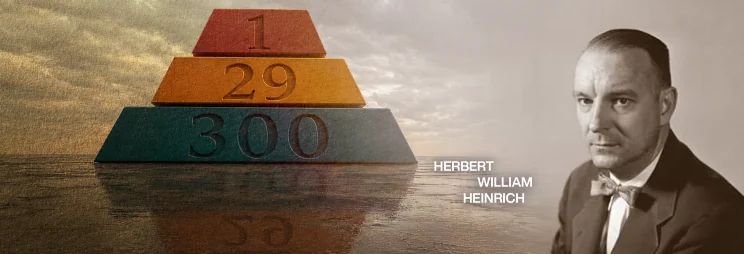
When Herbert William Heinrich published his book Industrial Accident Prevention, A Scientific Approach in 1931, his main goal was not to create a mathematical formula for safety. His ambition was much broader. He wanted to understand whether accidents followed observable patterns and whether preventive action could be taken before tragedy struck.
At the time, Heinrich worked for the Travelers Insurance Company and analyzed tens of thousands of industrial accident reports. What caught his attention was that accidents did not seem to come out of nowhere. They left traces and warning signs. They were preceded by smaller events that often went unnoticed.
This observation led to the famous ratio that would later become known worldwide as one serious accident, 29 minor accidents, and 300 no-injury incidents.

But there is an important point here. Heinrich never intended to claim that every fatality necessarily emerges from 300 near misses. He was trying to demonstrate something far more powerful. Systems begin to fail before they collapse, and the signs of that collapse usually appear long before the tragedy.
Perhaps the biggest historical mistake was turning a statistical observation into a universal law. Over the decades, many organizations began using the pyramid almost like a mathematical equation. “If we reduce minor accidents, we will reduce fatalities.”
However, a closer look at Heinrich’s original work reveals that his central concern was different. He wanted to convince leaders and companies that accidents should not be addressed only when they caused serious injuries. He advocated paying attention to early warning signs, examining deviations, investigating smaller events, and eliminating sources of risk before they produced irreversible consequences.
In other words, Heinrich was talking about prevention. We turned it into statistics. And there is a vast difference between the two.
Interestingly, when we read today’s discussions about serious injuries and fatalities, operational safety, HOP, Resilience Engineering, and High Reliability Organizations, we find something remarkably similar to what Heinrich was trying to build. It is the idea of learning from weak signals, examining work as it is actually performed, identifying precursors, and understanding how systems degrade over time.
Perhaps Heinrich was less concerned with the numbers at the base of the pyramid than with organizations’ ability to see what those numbers were trying to tell them.
There is another often overlooked aspect. Many contemporary criticisms claim that Heinrich blamed accidents exclusively on people. He did become known for stating that most accidents involved unsafe acts. Yet few remember that Heinrich himself wrote that no safety program could be considered complete without correcting or eliminating existing physical hazards.
This suggests that his perspective was broader than the historical simplification that ultimately endured.
He was not only saying, “correct behaviors.” He was also saying, “eliminate hazards,” “protect systems,” “reduce exposure,” and “interrupt the causal chain before an injury occurs.”
Perhaps the most important question today is not whether the 1-29-300 ratio is correct. Perhaps the real question is... are we seeing the warning signs that precede our most serious events?
Because that seems to have been Heinrich’s true obsession. Not counting accidents, but understanding the patterns that announce them before they happen.
When we examine major industrial disasters, aviation accidents, and catastrophic events in mining, oil and gas, energy, or transportation, we notice something they often share. The tragedy was almost never the first warning sign. It was simply the first one no one could ignore.
Before it, there were deviations, exceptions, normalized risks, small failures, warnings, reports, unease, and silence.
Perhaps Heinrich’s real contribution was not the pyramid itself. Perhaps it was the shift in mindset he tried to inspire, the idea that serious accidents should not be studied only after they happen. They need to be understood while they are still taking shape.
And perhaps this is exactly where Heinrich’s message remains alive almost a century later. Because the central question was never “how many minor accidents did we have?”
The question remains... what are we failing to see today that could become tomorrow’s tragedy?
I hope this reflection resonates with you.
Until next time.
Andreza
Watch my documentary about the history of the Titanic.
Watch my Headline Podcast
Would you like to learn more about my work? Purchase my books at the links below.
- Safety Leadership: http://bit.ly/44kFy2Z
- Antifragile Leadership: http://bit.ly/4ni6kBM
- 80 Ways to Expand Risk Perception: https://amzn.to/3VbWlAV
- Safety Culture: https://bit.ly/3x8IDXm
- Safety Culture Diagnosis: https://amzn.to/3XfnBkt
🧠 Follow me, Andreza Araújo , for more on EHS and leadership.
♻️ Repost this if you think it can help someone in your network!